THE HUMAN RHYTHM
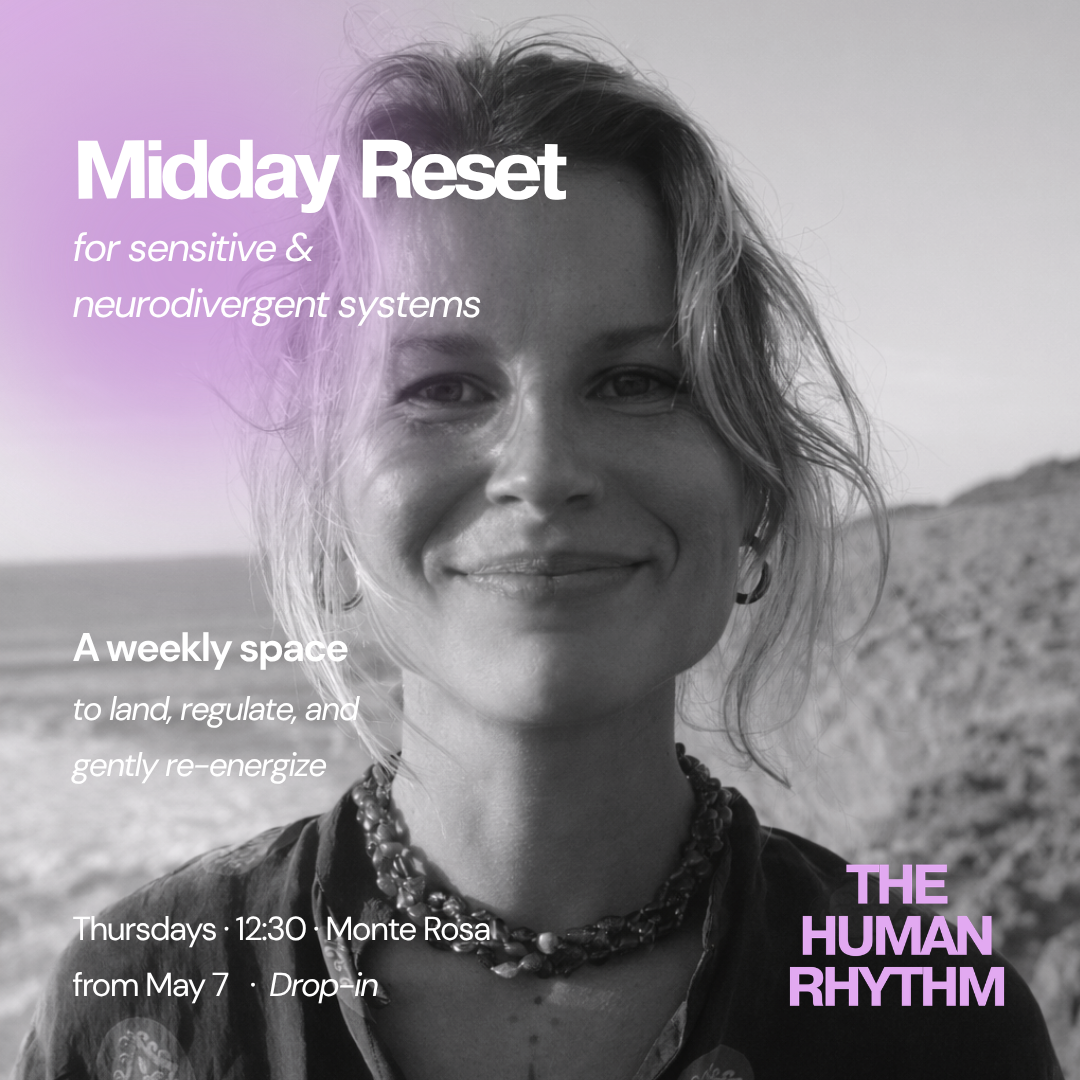
Midday Reset
for sensitive & neurodivergent systems
An open weekly space with Krys
In a world that constantly asks for attention – fast, full, and often overwhelming –
this space offers a pause in the middle of it.
Not only to slow down,
but to regulate in both directions:
calming the system when it’s too activated
gently reactivating energy when it feels low or stuck
So you can move through your day with more clarity, presence, and inner stability.
Especially supportive if you:
feel easily overstimulated or mentally full
are sensitive to people, noise, or fast environments
identify as neurodivergent or simply need more space to regulate
You don’t need to fit any label to be here.
If you recognize yourself in this, this space will likely feel supportive.
We work within The Human Rhythm Practice – using intuitive movement, breath, stillness, somatic regulation,
and clear communication in a way that is subtle, effective, and easy to integrate into daily life.
A quiet reset in the middle of the day.
From May 7: Thursdays · 12:30 – 14:00
Monte Rosa, Algarve · Roundhouse
20 € · drop-in
For the first weeks, I’m opening this space at a softer entry point.
To join, simply fill out the contact form below. <3
THE HUMAN RHYTHM PRACTICE
with Krys
Krys is the founder of The Human Rhythm.
The Human Rhythm explores how the nervous system, movement, communication and human connection shape
the way we live and work.
The Human Rhythm Practice combines movement, breath and sensing to release emotional tension, awaken fresh energy and reconnect with the natural rhythm of the body.
Drawing from somatic mindfulness, contemporary movement and breath-based activation, the practice offers simple tools that support clarity, presence and authentic connection.
Practices that can be integrated into everyday life.

Join the weekly Midday Reset! Simply fill out the contact below
Save your spot.
THE HUMAN RHYTHM
Experiental Space 01: TO BE
The Human rhythm at workTO BE is a curated experiential space
at the intersection of neurobiology, work psychology
and embodied practice.
The space brings together communication psychology, somatic awareness, breath and
body-based work with an understanding of the rhythmic nature of human performance and recovery
within the context of modern working life.
Daily life today is accelerated, condensed and increasingly shaped by digital environments.
Attention, communication and decision-making are under constant pressure.
The human organism, however, functions rhythmically. Focus, resilience and regeneration
do not arise in a continuous, uniform way.
Over time, a quiet form of overload begins to emerge - often unnoticed for a long time.
It appears as technostress, sensory overload, fragmented attention, inner distance,
reduced recovery or the feeling that despite responsibility and commitment
something essential is slowly being lost.
Digital systems and AI create new spaces of possibility. Yet these spaces are often not consciously integrated.
Instead, they quickly fill again with speed, information and expectations.
TO BE opens an experiential space
in which the human rhythm becomes perceptible again and tangible within everyday working life.
Not through increased performance. But through a conscious relationship with attention,
presence, transitions and connection.
Less inner compensation. Clearer decisions. More stable, more human collaboration.
The experiential space brings together embodied practice with insights from neurobiology, work psychology
and cultural development.
TO BE is body-based and shaped by communication, somatic awareness,
breath, presence and cyclical ways of working.
Designed for
Leaders and decision-makers
Teams in phases of transition or exhaustion
Organizations that want not only to implement New Work, but to embody it
People in positions of responsibility - for others and for themselves

-
Experiential spaces for nervous system regulation
Working with overstimulation, inner acceleration and mental fatigue - not analytically, but through lived experience.Navigating digital density
Integrating remote work, video calls, parallel communication and information load into a working reality that remains humanly sustainable.Working with transitions rather than tasks
Attention is placed on beginnings, interruptions, phases of intensity and closure - the moments where overload often emerges and remains unnoticed.Rhythm, pauses and presence
Experiential alternatives to constant availability and uniform pace - without an optimization mindset.Relationship, resonance and appreciation
Work is understood as a social process. Contact, tensions, missing recognition and cooperation are consciously included.Embodied learning instead of method transfer
Insights emerge through experienced shifts in state - not through tools, models or trainings. -
Work in digital environments
can only remain sustainable
when it stays aligned
with the human rhythm.TO BE opens an experiential space
that makes this visible.It shows what becomes possible
when people work with their nature
instead of constantly pushing against it. -
Technostress is a well-established concept in research - with clearly identified drivers.
Studies describe several forms of technostress, including techno-overload (too much, too fast), techno-invasion (work extending into private life), techno-complexity (increasing technological complexity) and techno-uncertainty (constant change). These dynamics are linked to mental fatigue, stress and reduced performance.Video calls create a specific and measurable form of fatigue.
Video conference exhaustion - often referred to as "Zoom fatigue" - has been empirically studied. Researchers link it, among other factors, to nonverbal overload, constant self-awareness, enforced eye contact and increased cognitive load. Validated measurement tools exist, including the Zoom Exhaustion & Fatigue Scale.Recognition is not a soft topic - it is a risk and protective factor.
The Effort-Reward Imbalance model (Siegrist) shows that when high effort is not matched by sufficient reward - including respect, status and recognition - the risk of stress-related health consequences increases. -
When the human rhythm is continuously ignored in everyday work,
measurable risks begin to emerge - economically and humanly.Typical consequences include:
rising sick leave and stress-related absences
technostress caused by information density, constant availability and digital overload
silent exhaustion among high-performing employees
loss of work-relevant capabilities in remote settings, such as concentration, self-regulation, clear communication and the ability to build relationships
inner disengagement and increased turnover despite modern work models
These effects are not only culturally visible -
they are economically relevant.TO BE starts earlier.
Not as a repair measure,
but as an investment in human work capacity
under digital and AI-supported conditions.
Interested in Experiental Space 01: TO BE?
Get in touch.
Human qualities are not soft skills.
They are becoming key competencies.
48 %
of employees worldwide report symptoms of burnout.
Boston Constulting Group; 2024
Belonging and relationship quality measurably reduce exhaustion -
often more effectively than many traditional performance measures.
BCG; 2024
21%
Only about
of employees feel emotionally
connected to their job.
Gallup, State of the Global Workplace
Technology is taking over tasks.
What matters now is how humans use the space it creates.